
Issue 7: BiDK 🔮
On ADHD, boundaries, and confusion.

Thank you for reading The Bi Monthly! If you like this newsletter, please consider becoming a paid subscriber—you’ll keep this content free for those who can’t afford it, and also get early access to exclusive content (coming soon)! 💖🌀👾
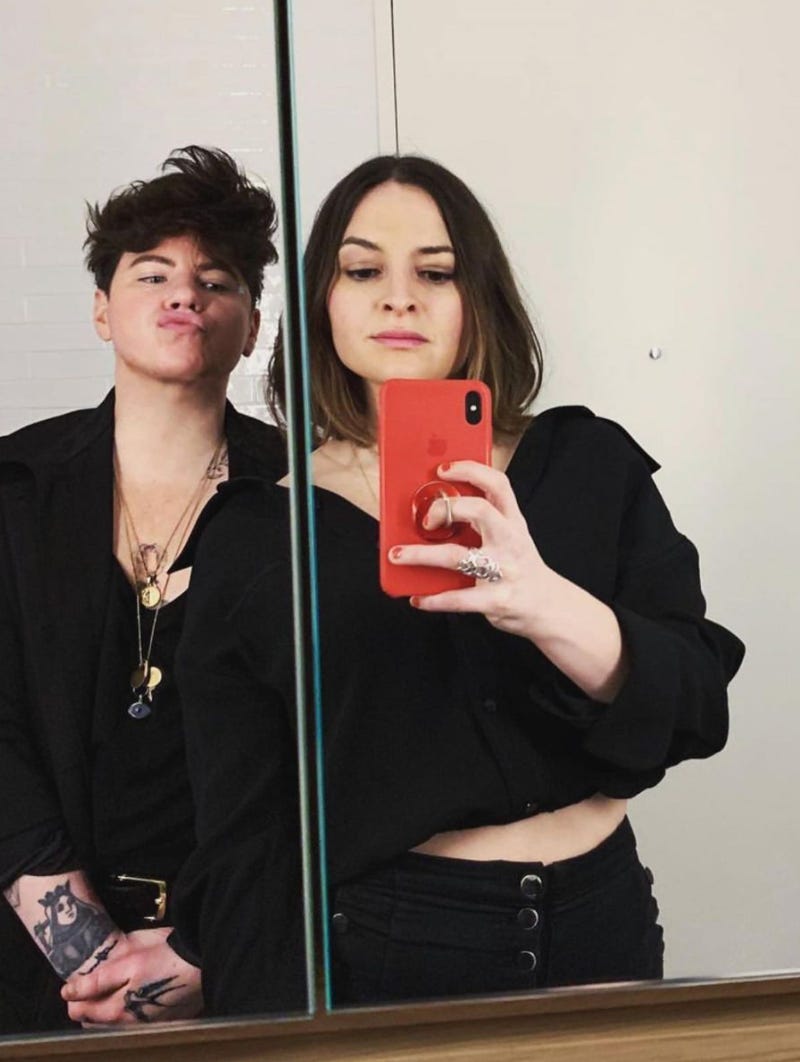
Hi friends! I love you! Happy one year anny to Covid Nine-Tina’s east coast debut and to this well-captioned pic of my partner and I:

You may remember that I’m currently on medical leave as recommended by my mental health provider (it sounds like copy-pasted legalese, but trust—it’s from the heart 💙). At the end of February, I was extremely anxious, stressed, and overwhelmed to the point that I wasn’t sleeping, and said mental health provider pointed out that this was worrying, especially considering my family history of mania (which I’ve written about before).
Ironically, most of my overwhelm was due to a very underwhelming villain: my regular schmegular ADHD. People (it’s me, I’m people) often perceive ADHD as an issue that “everyone has” or as something that’s “not a big deal” (remind you of any sexualities you know???). I’m guilty of underestimating ADHD for far too long, and it’s taken plenty of unlearning just to recognize the impact it’s had on my life.
Quarantine has only made that impact more pronounced. When we all started staying home, I was shocked to discover that not everyone lived in a state of complete and utter disarray. Most people remember to do basic self care (e.g. brush their teeth)? They finish household chores rather than stopping halfway through? They don’t constantly put the turkey in the cabinet and the plates in the fridge? Gasp!
I’m terrible at setting boundaries, for which I can thank my ADHD (and a lifetime of social conditioning telling me to people-please—u feel me ladies???). I tend to live according to what’s right in front of me (before I knew this was a trait associated with ADHD, I just thought it was a personality flaw). But alas, quarantine means that nothing is inherently right in front of me—I have to create my reality for myself. And over the last few months, that has led me to spiral out of control. 🙃
I’ve been using this time to focus on living with intention, and to (hopefully) regain control of my own life. A lofty goal, yes, but as A.J. Parkinson says, we’ve got nothin’ but time!
A few things have already helped me inch my way toward being an “organized person,” and I wanted to share them with you. Most of the below were recommended by my ADHD Coach Marla Cummins. Since some of you have inquired: Marla is wonderful but she isn’t taking new clients at the moment (as you can tell, she’s good at setting boundaries). But there’s so many amazing resources on her website—highly recommend digging through!
Here’s some stuff that’s helped me:
Focusmate: This is a website/tool designed to hold you accountable while you WFH. Basically you set up a session (50-minutes) and they match you with a random person for a video chat. At the beginning, you both say what you plan to work on, and at the end, you check in with each other about how much progress you made. I thought this sounded v cheesy and assumed no one would actually follow the guidelines, but people do, and this system WORKS! I’m in a session as I type this, and I can safely say if I wasn’t in one, I’d be laying down, playing home decor games on my phone. As a surprising bonus, the site is relatively gender inclusive—many people add their pronouns to their names and you can select if you’d only like to be matched with specific gender identities. I love it!
Things 3: When I tell you I’ve tried every to-do list tool, I mean I’ve tried EVERY to-do list tool. Todoist. Evernote. Notion. Clear. Google Tasks. Physical notebooks. Whiteboards. You name it, it has failed me. But I recently found Things, and I think I’m actually gonna stick with it?? The app is currently only available for iOS, and while it’s kind of pricey (~$50), it’s the only tool I’ve ever found that puts your calendar and tasks in the same place. I also just love the overall UX—my fave part is the Inbox area, where you can drop tasks without categorizing them (I usually get caught up with categorizing and forget to do the task itself). If you’re interested you can start with the 14-day free trial—be sure to read through their guidelines on the website!
Time-Locking Safe: I’m working on using my phone less in the morning and right before bed, so Marla (we’re all on a first name basis with her now, aren’t we?) suggested I lock my phone in one of these. Terrifying but also hilarious? I wish Substack had a poll feature so I could ask y’all if I should get one. (My partner will def say yes, so I’m sure I’ll have one by, like, next week.)
Journaling: This isn’t an original idea by any means, but I’ve been trying to do morning pages (Julia Cameron hive, rise up!) every weekday, aiming for 30 minutes or three full pages—whichever comes first. Free writing always helps me process my thoughts, though sometimes I start rambling. Fortunately, Marla gave me an amazing prompt that applies to my bigger goal of living with more intention: “What would today look like if I lived according to my values?” Asking myself this question in the morning inspired me to work out approximately 400% more this week than last week (read: I worked out four times instead of my usual zero).
Do you have any fave organizational tools? What’s the most effective way you’ve found to hold yourself accountable during the pandemic? How does ADHD manifest for you? Would love to hear your reccos, thoughts, and reactions in the comments on the Substack version of this post! (You can also share with me privately by replying to this email.)
Confuse Me Daddy 🤯
A few words on the liberating power of bisexual confusion.
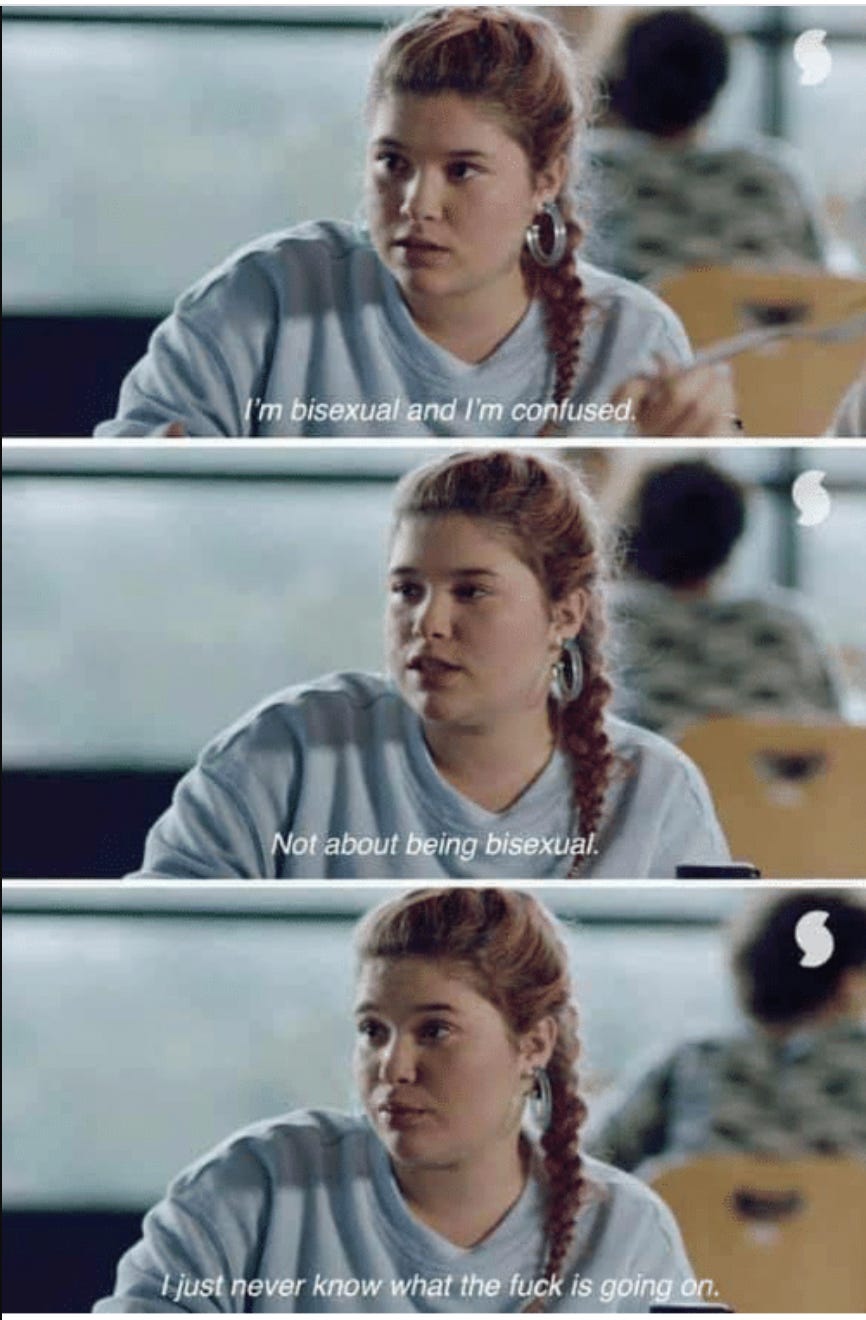
If, like me, you grew up frantically googling things like “can you be part gay?” or “cruel intentions kiss hi-res,” you’ve probably come across Bi 101 content—that is, memes, articles, and Tumblr screenshots that explain the basics of being bi.
This content tells us what bisexuality is, and often, it does that by telling us what bisexuality isn’t. One common format you’ll see involves countering bi stereotypes with statements like: “BI PEOPLE AREN’T CONFUSED” and “WE KNOW EXACTLY WHO WE ARE.”
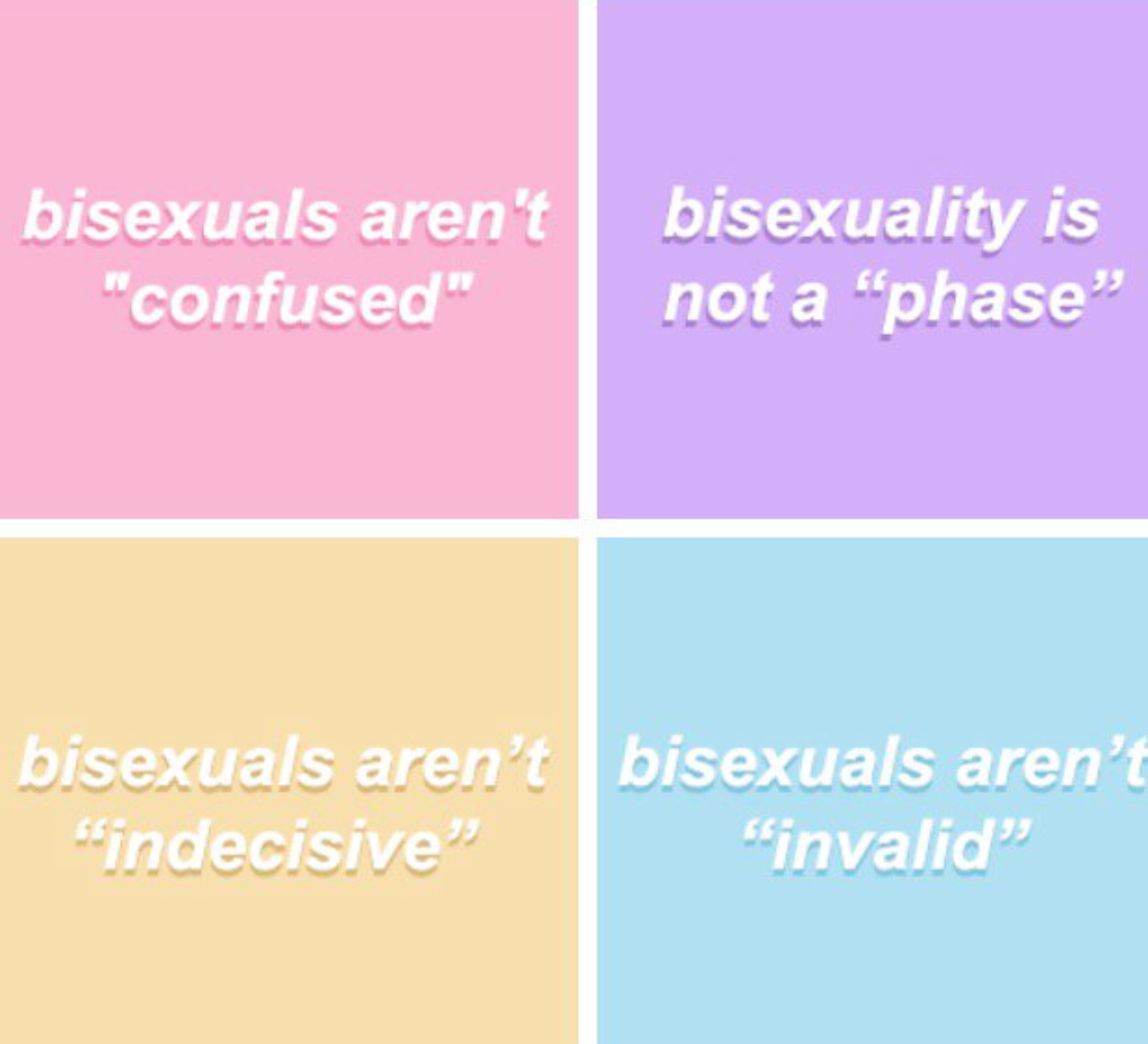
Growing up, I needed to hear this—I did feel confused, indecisive, and invalid, and tbh, I had no idea who the hell I was. I couldn’t tell whether I was gay or straight, and I didn’t think bisexuality actually existed. Thus this Bi 101 content (as it shall henceforth be known) helped me ~find myself~ (cue Taking Back Sunday playing at obscenely high mix levels over the credits). Slowly, I began to understand the contradictions of bisexuality—I learned that being bi essentially means knowing for sure that you don’t know for sure. And that made me comfortable enough to come out.
But even as I gained certainty about my sexuality, my confusion didn’t go away—it simply evolved. Instead of being confused about whether I was “bi,” I found myself confused about loads of other stuff, including but not limited to: how to balance my attraction to multiple genders, why the f*%^ I kept dating men, the nuances of my own gender identity, and so on. Even in the process of launching my book, I’ve been confused about how to position it. Should I talk to gay publications? Should I talk to straight ones? Why are there so few other books like this for me to compare it to?
Shiri Eisner wrote Bi: Notes For A Bisexual Revolution, a critical theory manifesto that has seriously changed my life (if you’ve read this newsletter before, you’ve probably heard me wax poetic about this book — go ahead and buy it). Shiri’s work taught me that bisexuality as a concept threatens the entire existence of binary structures, and helped me see the transformative power in confusion itself.
Here’s one quote that stuck with me (and that you will see quoted early and often in my book):
“Confusion points to instability as well as doubt, marking bisexuality as a vantage point for questioning, as well as marking a radical potential for change. Bisexuality can be thought of as a destabilizing agent of social change, promoting doubt in anything, starting with our own sexual identities, going through the structure of sex, gender, and sexuality; heteropatriarchy and racism; and ending with such oppressive structures as the state, law, order, war, and capitalism.”
Damn, amirite?
Confusion is often used to invalidate the idea of bisexuality or position it as something temporary. This leads to invisibility and erasure, which feed our hesitancy to come out, as well as the multitude of other challenges that bisexuals face—bi people have higher rates of psychological distress, bi women have a higher risk of intimate partner violence, and the majority of bi people aren’t out to the most important people in their lives.
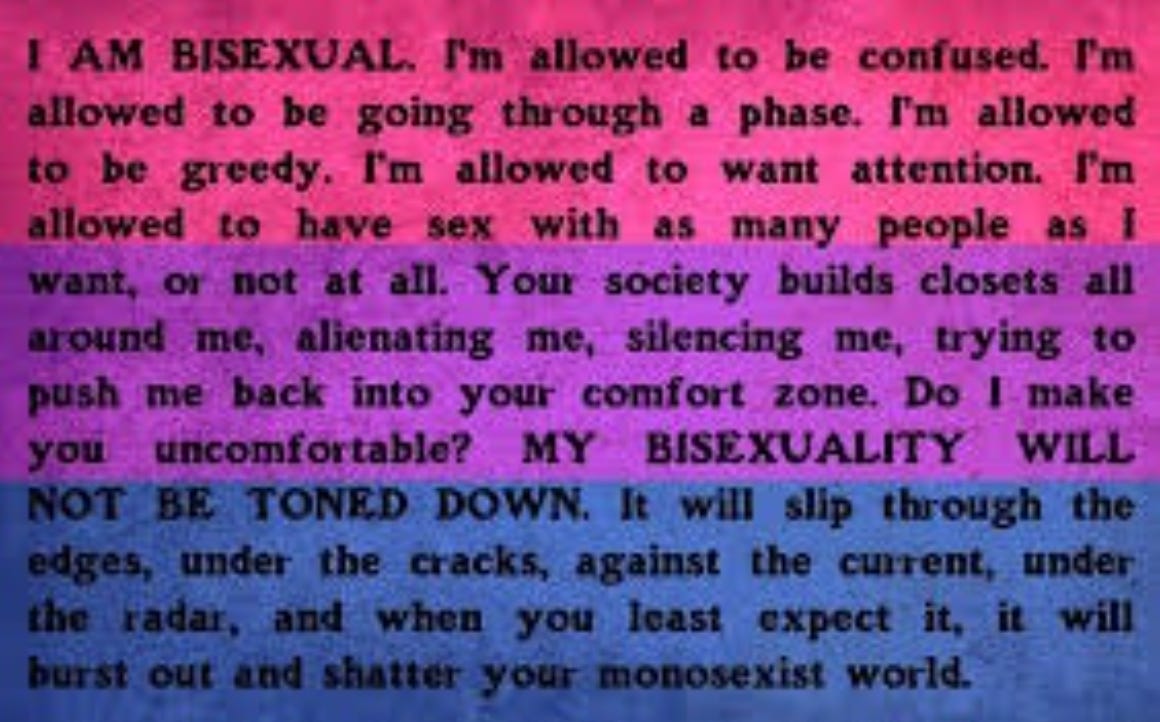
Knowing this, it makes sense that bi people try to deny any trace of our own confusion—saying that we’re sure about who we are is our way of asserting that we exist. But once we feel valid enough in our queerness, it’s important to sit with the idea of confusion itself, and ask ourselves why we still see it as such a negative thing.
As a concept, confusion embodies many of the values I strive to uphold. It involves asking questions, evolving one’s own perspectives, and committing oneself to lifelong personal growth. It’s literally been proven to strengthen our minds — according to NPR, “there's evidence that experiencing difficulties in learning can sometimes be desirable, leading to deeper processing and better long-term memory.”
We think of bisexual confusion as “bad” because of its perceived effects—if someone doesn’t know what they want, they’re presumed to be untrustworthy, sexually greedy, and unable to settle down. But if we unpack this even further, those effects are only “bad” when viewed through the lens of other patriarchal structures (monogamy, sex negativity, and the gender binary, respectively).
I’ve been thinking about this so much lately, and here’s a few questions I always find myself circling:
Why do we have to commit to something forever to make it meaningful? Doing so reminds me of being 18 and being forced to “choose a major,” which was code for “determine the course of the rest of your life.”
What’s so bad about being “in a phase?” My life has always been a series of phases, especially when it comes to hobbies—and I have a very eclectic hallway closet to prove it.
What’s so terrible about not knowing what we want? Here’s another thing I learned from Shiri’s book: Patriarchy has taught us to perceive firm, singular decision-making as an inherently “masculine” trait, which is yet another reason why bi men are often overlooked and dismissed (homophobia + the inability to decide = “femme” traits squared). We’ve also been taught to see multiplicity or indecisiveness as inherently feminine (thus '“weak,” per the patriarchy).
The reality is that confusion threatens those patriarchal norms. It pushes us to read between the lines and interrogate the choices we were given to begin with. And while this way of thinking about confusion can apply to so many different identities, concepts, and other ideas that don’t fit perfectly into binary structures, it’s incredibly relevant to bisexuals—precisely because we are so often invalidated and dismissed for our confusion itself.
Just because confusion is the stereotype doesn’t mean it’s the enemy. Patriarchy is the enemy (in this case) and confusion simply serves as a challenger, disrupting the binary systems and rigid gender roles that shape our world. After reframing the concept of confusion, we can see that it isn’t our detriment, but our superpower. Transcending binaries is a necessary tenant of all liberation, and for bi people, that just happens to part of the fabric of who we are.
5 Links You Should Click 👅💦
This Wear Your Voice piece on The Lobster and society’s disdain for singles.
This Bustle piece on the complexity of qualifying for the vaccine due to obesity.
This bullshit 😡 — a piece from them that tells us more anti-trans legislation has been introduced this year than ever (yes, in 2021).
This NYT piece on the importance of white privilege conversations w/r/t Prince Harry.
This newsletter from Molly Frances on cancel culture as accountability spectacle — a very important read.
Thank you so much for reading and subscribing to The Bi Monthly! I love you and I’m so grateful you’re here!
As mentioned up top, this newsletter now has a paid option—if you’d like to support me directly, feel free to subscribe. Paid subscriptions will also include early access to exclusive content—stay tuned 🥳🥳🥳
Note: Earlier versions of this newsletter said that the paid option would be for donations. This was always my intent, but circumstances have changed—for one, writing this newsletter takes a TON of time and energy, and I’ve done a lot of grappling with the fact that I deserve to be compensated for my work (or at least give people the option to support). Any subscriptions would be supporting me directly, as well as compensating future guest writers. I thank you greatly for it! ❤️